Hieroglyphic “Writing”Hieroglyph, “sacred carving”, is a Greek translation of the Egyptian “the gods’ words”, and was used at the time of the early Greek contacts with Egypt to distinguish the older hieroglyphs from the handwriting (demotic) of that time. No one seems to know the origins of the hieroglyph, but it apparently came into being in the late predynastic period (pre 3100 B.C. or C.E.). With the exception of some names and a few titles, the oldest inscriptions can not be interpreted. All attempts to decipher the hieroglyphic inscriptions before 1800 were totally unsuccessful because the pictures were believed to be composed of mystic symbols. This belief was slow to die out even after the discovery, in August of 1799, of the Rosetta stone that had inscriptions found in two languages with three different inscriptions: Egyptian hieroglyphics, Egyptian demotic, and classical Greek. The Rosetta Stone, a critical discovery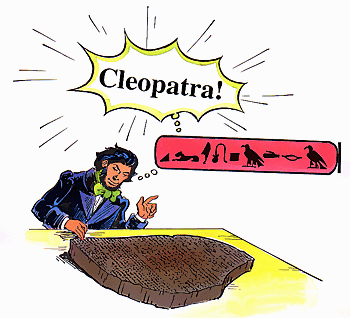 French scholar Jean François Champollion (1790-1832), with the help of other scholars, was able to finally interpret much of the Rosetta Stone and the cartouches in the hieroglyphic section. When Champollion compared a cartouche from another scholar that spelled the name Cleopatra with the cartouche of Ptolemy on the Rosetta Stone, he could see that they showed three signs in common and they occurred in the expected positions if the name Ptolemy and Cleopatra were spelled alphabetically. This was enough to persuade him to abandon his previous theory that hieroglyphs were mere symbols and to adopt the view that at least in some cases they had phonetic values. He knew that Thomas Young (1773-1829) had reached this conclusion before him but he never admitted it in print. In September 1822, Champollion presented an important report in which he corrected and greatly enlarged the list of phonetic hieroglyphs drawn up by Young and correctly deciphered the hieroglyphic forms of the names and titles of most of the Roman emperors of Egypt. Between then and his early death, he is given credit for drawing up a classified list of hieroglyphs, identified the names of many Egyptian kings, and formulated a system of grammar and general decipherment. Whereas Young had been unable to make any substantial progress after finding the key to the problem of decipherment, Champollion went on to lay the foundations on which present knowledge of the language of the ancient Egyptians is based and he is rightly looked upon as the Father of Decipherment of Hieroglyphs. Although Napoleon hoped to gain scientific profit from his Egyptian expeditions, his military efforts were a failure. There was a valuable discovery; however, on August 2, 1799, when the French Brigadier-General Bouchard ordered his men to dig in by the old Fort Rashid, later called Fort Julien, about five miles from Rosetta in the Nile delta. While digging into the ruins of a wall, there was a metallic clang as the pick, or shovel, hit a large stone with some kind of writing covering the flat surface. The inscription turned out to be a memorial dated equal to March 27, 196 B.C. issued by the priests of Memphis in gratitude to Ptolemy V Epiphanes for gifts “which had increased the honors due to the king and his forefathers in the Egyptian shrines.”
It was later determined that, as was customary in the Ptolemaic era, this memorial was to be inscribed on a commemorative tablet in the three languages of the country: Hieroglyphs were readable from three directionsHieroglyphs could be written either right to left, or left to right, or top to down; the lines being either vertical (reading down) or horizontal (reading across). The hieroglyphic figures always faced the beginning of the line. In an inscription that read left to right, the signs faced to the left, or they faced to the right to indicate that one should read right to left.   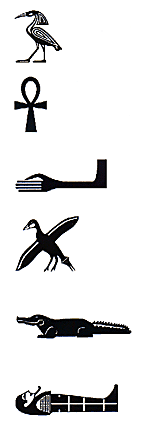 Although hieroglyphs worked fine
In their Egyptian day, It bothers me that in each line The glyphs all face one way. And looked they left or right, as it Might suit the writer’s aim, It didn't matter, not a bit— The meaning stayed the same. “. . . those learned scribes . . . made heirs for themselves of books of Instructions they had composed . . . books made them remembered.”
The hieroglyphic fonts used in this report came from Deniart Systems (Denise and Jan Koehler, Egyptian Hieroglyphics, Toronto, Canada: Computer Fonts, 1993). In the introduction to their manual, they state: “The study of Hieroglyphics has been an ongoing fascination by scholars and Egyptology buffs for literally centuries. To this day, a positive interpretation of the hundreds of symbols discovered cannot be ascertained. Although the discovery of the Rosetta stone in 1822 [sic] provided an incredible breakthrough, there continues to be conflicting opinions on the literal translation of both the phonetic and ideographic or pictorial symbols. As such, the interpretation provided in this manual represent an assembly of the most popular transcriptions.” As to authenticity, they write, “The ornamentation of the signs created for this package were created for visual appeal, while retaining the relative form and structure of the signs.”  |